This intensive, two-day workshop prepares participant to teach the concepts of results accountability and coach others in its implementation. Participants will learn how to:
- conduct their own Results-Based Accountability™ workshops;
- lead training exercises; and
- help organizations and their leaders put these practices into operation.
Instructions for Setup, Logistics, Materials and Preparation The two day Training for Trainers and Coaches workshops require preparation that is different from Results Accountability 101 sessions. This page tells you what you need to know to prepare for this training. Many thanks in advance for your help!
Contact Us to Get Started
- Selection of Participants: Training for Trainers and Coaches is an intensive two day session designed for people who have already been through RBA 101 training and are set to serve as in-house experts for the next stages of work. Total participation is limited to no more than 24 people. The training is designed to give individual attention to each participant. FPSI can provide consultation on the process of selecting the right people to attend. Some participation prerequisites are listed under Participant Preparation below.
- Click here to see a useful set of selection criteria developed by the Los Angeles County Department of Public Health.
- Click here to see the criteria and application form used by the Maryland Governor’s Office for Children.
- A pre-training conference call will be needed ahead of the training to confirm the times set out in the agenda and consider any adjustments which may be necessary.
- Room Setup, Equipment and Food: Much of the preparation is the same as for other FPSI workshops.
- The room should be set up with tables for four people to sit around. The wall space should accommodate 7 pieces of flipchart paper side by side (for the whole distance exercise).
- An LCD projector should be set on a rectangular table (NOT and AV cart please) at the front of the room.
- A large screen (not necessary if there is a large clean wall surface for projection)
- Participants will work in groups of 4 “learning allies.” Each group will need its own table, flipchart and flipchart stand and set of markers.
- Masking tape or (better) Blu Tac adhesive putty (for sorting exercise)
- Please place a 5th chair at each table for the trainer to listen to the work.
- No microphones are needed for groups of 25 or less.
- Name tags with first names in large type. These can be pre-prepared or filled out at the time of the workshop.
- Pitcher of water and glasses for each group and on the front table, please.
- It is necessary to have lunch provide both days on site. Box lunches are best as they allow groups to break for lunch at slightly different times (and continue work over lunch where this is useful).
- It is helpful (maybe even fun) to have modeling clay or stress toys on the tables.
- It’s very helpful to have chocolate on the tables in the afternoon.
- Comfortable, casual dress is encouraged.
- Participant Preparation
- Participants are asked to answer the questions on the Results Accountability Self Assessment Questionnaire (see below).
- Participants are asked to spend at least 1 hour playing with the website: www.raguide.org. Click on the Index of Questions and find something that looks interesting. Review the Index of Tools and review instructions for at least one exercise or technique. Recommend review of the “Leaking Roof” or “Whole Distance” exercises.
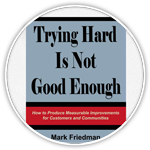
- Participants are encouraged to read Trying Hard Is Not Good Enough (available from www.resultsleadership.org), and to bring the book with them to the workshop.
- Advance reading may also be helpful from the website resultsaccountability.com. Recommended website documents include: UCLA Results Accountability for Young Children and Their Families, and the What Works Policy Brief – Reforming Finance, Financing Reform
- Participants are asked to have a time on their schedule in the next 30 to 60 days when they will make a short (minimum 15 minute) presentation about Results Accountability.
- Data: For the Community-wide Population (e.g. all children, all elders) Turn the Curve exercise: the group will need 4 or more indicator baselines with room on the x and y axis for forecasting. An existing state, county or city Quality of Life or Children’s Report card can be used if it provides graphed baseline data for 4 or more indicators.
- Data: For the Program and Agency Turn the Curve exercise: staff should bring (if possible, but not required) a list of key performance measures used by their organization and real data for at least one lower right quadrant measure.
Back to back printing is always preferred as a way to save paper. To be distributed in advance of the workshop:
- Training for Trainers and Coaches Agenda (Word file) (4 pages)
- Results Accountability Implementation: Self Assessment
- (1 page) This is Appendix A from Trying Hard Is Not Good Enough. Answering these questions will help participants determining how far along their organization is in implementing Results Accountability.
To be distributed at the time of the workshop. The following materials should be put together in a 3 ring binder with section dividers:
- TAB 1
- Another copy of the Training for Trainers and Coaches Agenda (4 pages)
- Participant list with name, organization, address, phone and email
- TAB 2
- Training for Trainers teaching curriculum summary
- (1 page) This shows each of the 5 teaching segments and workbook slide numbers for each. This is intended to guide the planning for the participant provided training.
- Results-Based Accountability Competencies (1 page)
- This document shows the explicit progression of desired competencies in three areas directly addressed in the training: Language Discipline, Results Accountability and Performance Accountability. In each area, the progression from Understanding to Teaching and Coaching to Acting and Leading is described.
- Training for Trainers teaching curriculum summary
- TAB 3
- The RBA Flyer
- (A1.2; 2 sides of one page): This is the latest document to put all the essential ideas of RBA on one piece of paper – written expressly for a lay audience. It could be a useful tool in teaching RBA concepts. Black and white copying is OK.
- 101 Workshop Handout Material
- (Item A1.1; 45 pages) A full set of the RBA 101 Workshop handout material will be needed for this training. Participants should be asked to bring the copy they received at the 101 Training session. Additional copies should be on hand for those who forget the bring it. (See Workshop Material Item A1. for instructions on how to print this.) Note that all RBA 101 workshops are now using the Powerpoint version of this material and that should be the version printed for this training.
- The RBA Flyer
- TAB 4
- RBA Coaching Scenarios
- (1 page): These are case study examples help participants think about how they would handle common coaching or consulting challenges.
- Selected Exercises
- (9 pages) Setup and implementation instructions for 7 essential teaching exercises, including: the Turn the Curve Exercises for both population and performance, a Tool for Choosing a Common Language, The Whole Distance Exercise, the Results List from Scratch Exercise, the Performance 20 minute Exercise and two Performance Measurement Puzzles.
- The Collaboration Game
- (OPTIONAL – 6 pages): Most games have a winner and a loser. The basic version of The Collaboration Game is one where the only way to win is for everyone to win. But there are also variations which simulate the different roles and conflicting objectives found in real life groups working together.
- RBA Coaching Scenarios
- TAB 5
- Raguide.org Index of Questions
- (5 pages) One purpose of the training is to familiarize participants with the resources available to support their work. Raguide.org is one of the most important of these resources, and these pages will allow us to reference specific website material during the training session.
- Raguide.org Index of Questions
- TAB 6
- Evaluation forms (3 pages) While the following forms are recommended, sponsors may use these forms , or forms of their own design, for participant feedback on the quality of the workshop.
- Form #1 Summary: 1 copy of a 1 page form for each participant
- Form #2 RBA Detail 1 copy of a 2 page form for each participant. This detailed evaluation form is divided into 4 sections: Skills & Knowledge, Attitude, Behavior and Circumstance. It is intended to demonstrate how the principles of performance accountability can be used to structure evaluations. If this form is used, two copies will be needed for each participant.
- Evaluation forms (3 pages) While the following forms are recommended, sponsors may use these forms , or forms of their own design, for participant feedback on the quality of the workshop.
Non-Tabbed Material
- Sorting Exercise (4 – 8 pages): Another important teaching exercise, the sorting exercise starts with mixed up card decks of elements from a community effort to improve results. The exercise allows teams to put them in the right place in the talk to action thinking process. Select and prepare enough (usually three to five) card decks for each of the following three scenarios (so that groups have a choice about what to work on).
- Instruction Sheet: One per table Scenarios (3 sets of each)
- a. Community effort to reduce the Teen Pregnancy rate
- b. Community effort to get All Children Ready for school
- c. Community effort to achieve a Clean Environment
- Special preparation instructions: Each group of 4 participants will need a separate card deck. A card deck consists of all the cards from one scenario cut up and put together with a rubber band (or clip). The card decks should be prepared by printing the scenarios (3 pages each) on different color paper or card stock (e.g. Teen Pregnancy: blue, Ready for School: Red, Clean Environment: Green). Cut each deck into individual cards. MAKE SURE you keep all the cards from the scenario together. When finished you should have 3 to 5 decks for each scenario (if using card stock each deck will be about 2 inches high).
- Trying Hard Is Not Good Enough Workshop organizers are strongly encouraged to provide a copy of the book “Trying Hard Is Not Good Enough” for each participant. The Results Leadership Group provides significant discounts for anyone organizing RBA workshops. Contact Adam Luecking at adam@resultsleadership.org. It is likely that some participants will already have a copy. If you give a copy to each participant, the ones who already have one can give their new copy away when they get home as a way to help spread the work.
- Certificate of Completion: Sponsors should plan to provide a certificate to each participant. A blank certificate form is provided in Powerpoint for each of the following:
- Sponsors must make their own arrangements for printing these. Blank certificate paper can easily be obtained from most office supply stores. And someone familiar with Powerpoint can produce a file of certificates with each participant’s name printed in the center. If the FPSI certificates are used, the trainer will sign the certificates at the time of the training.
- Next Generation Contracting Provisions